Current Projects
Main content start
WHD researchers work to create the knowledge, skills and solutions needed to support effective management of water and wastes, and to ensure sustained, equitable access to water supply and sanitation services. Our research addresses issues such as water quality and quantity, sanitation and hygiene, health and resource recovery for energy and food production.
Site Pages
- Boreholes with handpumps are the most common type of improved drinking water source in rural Africa, but 18% to 36% of them are not functioning.
- A 2018 report on healthcare facilities in 78 developing countries revealed 50% lack access to piped water, 39% to handwashing soap, and 33% are without improved toilets.
- WHD is the Strategy Measurement, Evaluation, and Learning (MEL) partner, supporting the Conrad N. Hilton Foundation (CNHF)’s water team.
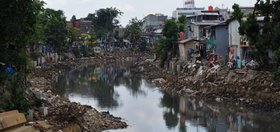
- Revitalising Informal Settlements and their Environments (RISE) aims to provide research-based evidence that a localized, water sensitive approach to revitalizing informal settlements can deliver sustainable, cost-effective health and environmental improv
- Ali Boehm has been leading a team in developing new methods for deriving risk-based thresholds to define “safe” waters for recreational contact.
- Understanding the benefits of providing piped water on premises is particularly important as the costs are typically at least two times greater than other sources, such as communal pumps.
- Ali Boehm received a new grant from NSF to study norovirus persistence in surface waters.
- The Lotus Water project provides solutions for the more than 500 million people living in cities of the developing world who have piped water service but receive water that does not meet international standards for safety...
- The Extreme Poverty, Infrastructure and Climate Initiative (EPIC) aims to amplify the poverty-alleviating impacts of infrastructure investments, particularly in sub-Saharan Africa. By 2030, eight of every ten people living in extreme poverty are projected
- In 2012 California enacted legislation upholding a human right to water, becoming the first state to recognize the right of all citizens to clean, affordable drinking water. This project is analyzing how household water affordability, access and equity is
- This project aims to provide critical information to understand, address and contain COVID-19 while also helping better prepare scientists, engineers and public health officials for future coronavirus outbreaks. Coronavirus persistence, environmental tran
- Research Area: Technology development, Sanitation & wastewater, Water quality & treatment - The accumulation of untreated fecal sludge – the waste product from sanitation systems without a sewer – leads to water contamination from carbon, nutrients...
- Research Areas: Health behavior, Human health & medicine, Rural services & development, Sanitation & wastewater - WHD, Sesame Workshop and World Vision have partnered together to investigate key impacts and outcomes of the WASH UP! program.
- Research Area: Policy & planning The Water Data Dialogues is a series of online discussions with the ultimate goal of improving the quality of decision-making in the water sector of low-and-middle income countries (LMICs). Near-term objectives include ide